Picture yourself sitting in a quiet room, ready to test your mental speed. Words flash on the screen in bright colors: the word RED printed in blue ink, or GREEN printed in yellow. Your instructions are simple: name the color of the ink as fast as you can, and completely ignore what the written word actually says.
It sounds effortless. Yet the moment you begin, your brain stumbles. You find yourself accidentally reading the word aloud instead of naming its ink color, or freezing for a crucial split second as your internal systems battle for control. Why does something as elementary as reading a color name suddenly become so agonizingly difficult?
We tend to think of our minds as streamlined computers that execute commands without friction. But the human brain is a tangled web of competing pathways, built on deep evolutionary habits and learned automatic reflexes. Take the interactive Stroop test below to experience this cognitive tug-of-war for yourself, and discover how your brain handles the sudden friction of clashing signals.
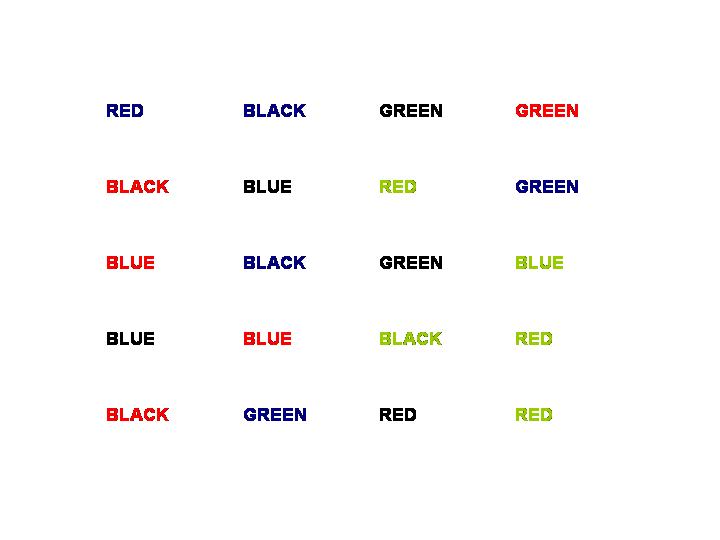
Try it
Do you predict that your reaction time will slow down significantly when the ink color clashes with the written word, and why do you think your brain gets tripped up by reading words you are actively trying to ignore?
Stroop test
24 trials · about 1 minuteWords will appear one at a time. Answer with the color of the ink, and ignore what the word says. Go as fast as you can without guessing.
On a keyboard press R, B, G or Y. On a phone, tap the buttons.
Average time for correct answers. Mistakes are left out of the timing.
After completing the trials, your results show a distinct numerical gap known as the Stroop cost: the difference in milliseconds between your matching trials (where the word and ink color agree) and your clashing trials (where they disagree). For most people, clashing trials demand extra milliseconds of processing time and cause a spike in error rates.
This delay happens because reading is a deeply entrenched, nearly automatic habit. By the time you reach adolescence, you have spent tens of thousands of hours scanning text and extracting meaning without conscious effort. When a word like YELLOW appears in red ink, your brain reads the semantic meaning of the word in a fraction of a second. To answer correctly, your prefrontal cortex has to aggressively step in, suppress that automatic reading reflex, and force your nervous system to focus strictly on the physical pigment of the letters instead. That internal override mechanism is what creates the Stroop delay.
The science
The dual-processing bottleneck
To understand why the Stroop effect is such a powerful window into human cognition, we have to look at how information moves through neural architecture. When visual stimuli hit your retinas, electrical signals race along the optic nerve to the visual cortex at the back of your brain. From there, information splits along two primary processing streams: the ventral stream for object and color recognition, and linguistic pathways dedicated to language and semantic reading comprehension.
In literate adults, the pathway responsible for reading words is exceptionally fast and myelinated. It operates largely outside of conscious awareness. Conversely, naming an abstract ink color requires more deliberate, controlled attention. When these two pathways fire simultaneously with conflicting instructions, such as seeing the word BLUE printed in green ink, they create a bottleneck in the brain’s processing pipeline.
The battleground in the frontal lobe
Resolving this bottleneck requires intense coordination across several key brain regions, which you can explore on the interactive diagram on this page:
- The Prefrontal Cortex: Acting as the executive control center, the prefrontal cortex holds your current goal in mind (“name the ink color, ignore the word”) and exerts top-down control to amplify the weaker color-naming signal while actively inhibiting the stronger word-reading reflex.
- The Amygdala: While the Stroop test is not a life-threatening emergency, the sudden cognitive friction and unexpected mistakes can trigger a micro-burst of frustration or physiological arousal, engaging the amygdala’s monitoring networks.
- The Hippocampus: Working behind the scenes, the hippocampus compares your current task against past trials, helping you learn from mistakes and adjust your strategy as the test progresses.
- The Hypothalamus: Operating as the master regulator of internal bodily states, the hypothalamus ensures your autonomic nervous system maintains optimal alertness and metabolic readiness throughout the cognitive challenge.
Neural interference and cognitive control
Psychologists refer to this phenomenon as response interference. The brain cannot execute two contradictory motor and cognitive plans with equal force simultaneously. One must dominate. When the automatic response is suppressed, the brain incurs a metabolic and temporal tax. This foundational discovery has made the Stroop task one of the most reliable and widely used tools in neuropsychology for measuring executive function, attentional control, and prefrontal health across diverse populations, from healthy students to clinical patients dealing with neurological conditions.
Notice in the Crash Course Psychology breakdown (Consciousness: Crash Course Psychology #8) how our conscious awareness represents only a tiny fraction of the total processing power humming beneath the surface of our minds. Most of our daily mental life consists of automatic, unconscious processing running on autopilot. The Stroop effect gives us a rare, tangible glimpse into the machinery of consciousness, showing us exactly what happens when our automated background programs collide with our conscious intentions.
Why it matters
While taking a color-word test on a screen might feel like a clever parlor trick, the exact same neural machinery powers every complex decision you make in daily life. Every time you resist an impulse, filter out distractions in a chaotic classroom, switch focus between multiple challenging subjects, or regulate your emotions during an argument, you are utilizing the exact same prefrontal control networks measured by the Stroop effect.
Furthermore, research in cognitive psychology and public health demonstrates that executive functioning capacity is deeply influenced by our environment. Chronic stress, sleep deprivation, food insecurity, and neighborhood instability all take a heavy toll on the prefrontal cortex. When a student is running on four hours of sleep or carrying the invisible weight of chronic environmental stress, their brain’s executive control center has less biological bandwidth available to resolve cognitive interference. Consequently, everyday academic tasks require vastly more exhausting mental effort. Understanding the science of cognitive control helps shift our perspective away from blaming individuals for momentary lapses in focus, highlighting instead how crucial supportive, stable environments are for healthy brain development.
Try this at home
You don’t need a computer laboratory to explore cognitive interference. Try creating your own physical Stroop challenge on a sheet of paper. Write out color names (RED, BLUE, GREEN, YELLOW) using mismatched colored markers, and time a family member or friend as they try to name the ink colors as fast as possible. Swap roles and notice how difficult it is to completely turn off your reading reflex. Afterward, discuss how practicing mindfulness or taking brief mental resets can help clear cognitive fatigue when your brain feels overloaded.
Sources
- Stroop, J. R. (1935). Studies of interference in serial verbal reactions. Journal of Experimental Psychology, 18(6), 643-662.
- MacLeod, C. M. (1991). Half a century of research on the Stroop effect: An integrative review. Psychological Bulletin, 109(2), 163-203.
- Consciousness: Crash Course Psychology #8. CrashCourse.